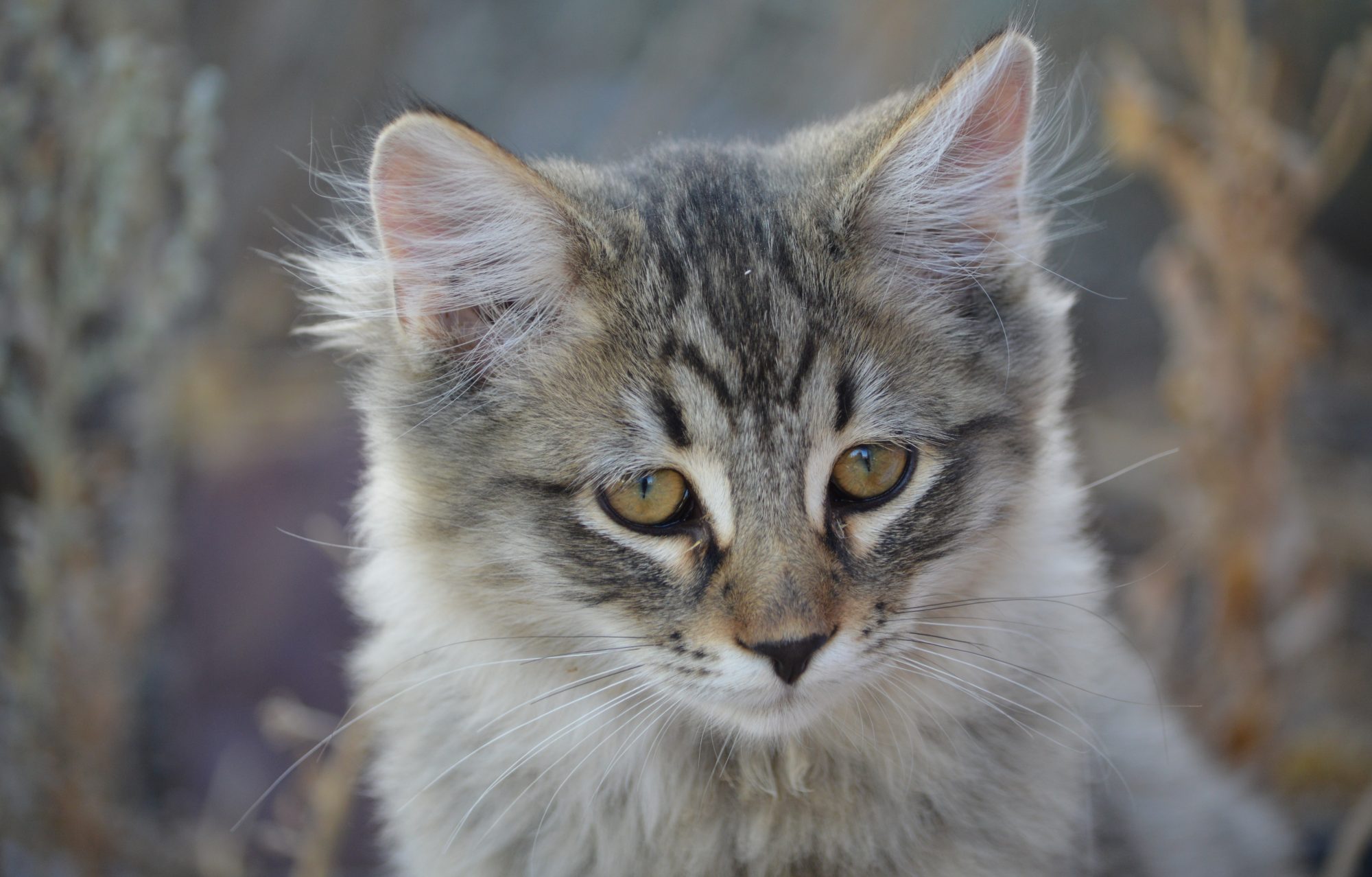
Just as the cattle operation was winding down, Hillcrest Farms became an unintentional cat sanctuary. Years before, it had been dogs that showed up. People dumped them off, they escaped, they found their way here. After a time, I looked heavenward and said, “Please, no more stray dogs.” The prayer was answered. Eventually, the dogs grew old and passed away. At some point, I’ll add a dog page here to memorialize them.
There was some overlap between the dogs and the cats. In my early years here, in my naivete’, I had tried to grow things that will grow elsewhere but not here. One of them was cats. One cat lasted for several years, but eventually all disappeared, presumably due to coyote predation, and I made a “No More Cats!” rule. Some time later, a granddaughter talked me into trying one cat. Surprise – he worked out! Behaving more as a dog, he helped me with chores both indoors and out, and came inside with me after evening chores were done. When let out, he never left the yard. He’s still here nearly ten years later.
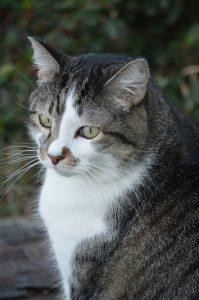
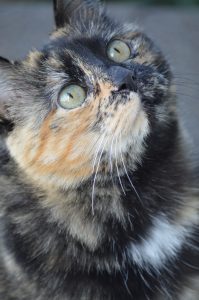
For some reason, the early success with Fitty led me to adopt Scotch at a humane society “free cat” weekend. A couple years later, the feed store people talked me into adopting one of their tortoiseshell barn cats. She needed to be spayed, which was accomplished shortly after welcoming her to the fold.
A few feral strays appeared and disappeared. A long haired one that was mostly white sheltered beneath an old mobile home and disappeared after a blizzard.
A gray tiger tomcat came to the patio to be fed. My research into no-kill shelters turned up a few, but most had contact information that no longer worked, or had very long waiting periods. The tomcat disappeared shortly thereafter.
A long-haired black tomcat came and went for a few years, in the summertime trying to fight through the window screens with Fitty (who had been neutered). Rarely, the black tomcat was accompanied by another cat.
Late one November, I was doing chores at the chicken houses. The chickens had already gone to roost, it was dark, and I was closing up the pens and houses for the night. I wore a headlamp, and turning around from fastening one of the doors, the light reflected from a low pair of blue-green eyes watching me. I spoke to the eyes, she decided I was alright, and she helped me finish the chores. This one was not feral. She had been somebody’s pet, and she immediately became the fourth house cat.
Bootsie is a tiger stripe with bits of brown mixed with the gray, and white on her feet that gave her her name. Immediately upon her arrival, the long-haired black tomcat returned. Bootsie, it turned out, had not been spayed. She immediately became pregnant within days of her arrival. Two months later she gave birth to five kittens, all of whom were spayed or neutered when they became of age. What I didn’t realize was that a cat could go into heat while their kittens were still small and nursing.
I had planned on getting Bootsie spayed as soon as she was no longer providing milk for her first litter. I kept Bootsie in the house most of the time, but one fine day I let her outside for some fresh air and sunshine. I kept watch over her, to make sure no tomcats came around. And I saw none. At lunchtime, I came in the house just long enough to make a sandwich and go back outside. In that short space of ten minutes, the black tomcat came courting. Bootsie became pregnant when her kittens were only about four weeks old.
She had another litter – nine kittens, one immediately crushed inadvertently in the birthing box. I found homes for four, and kept four. They, too, were spayed and neutered — as well as Bootsie — when they were of age…except for two that had become quite wild and I wasn’t able to catch. After a while I caught the male, and had him neutered, but the female had a litter of kittens in one of the chicken houses.
When Bootsie’s first litter of kittens was three or four months old, another tomcat appeared. This one was long-haired and light orange. When we gazed into one another’s eyes, I yearned to feel the sense of peace and serenity that I saw there.
Peachy loved people. He loved Bootsie’s kittens. Bootsie’s kittens loved him. Especially Bobbi-cat — they were in love, or at least she deeply loved Peachy.
When I took Peachy to the veterinary office, he loved the ladies there, and the ladies loved him. I thought Peachy would have been at home in a place of business, with friendly people coming and going all day. If ever a cat possessed a touch of the divine, it was Peachy.
A source of sadness and frustration for me, though, was that Fitty and Peachy did not get along with one another, so I wasn’t able to let Peachy fully become a house cat. If Peachy was in the laundry room with Bootsie’s kittens, he and Fitty might scrap at the vent in the closed door. If Peachy was outdoors on a summer day, he and Fitty might try to fight through the window screen.
During one such altercation, I stuck a leg in front of Fitty to back him away from the window. In his anger he bit me, a good, deep wound. Over the phone, the lady at the doctor’s office told me to, “keep an eye on it.” I had already googled cat bites, and knew that it should be treated with a prophylactic round of antibiotics. I wound up in the emergency room, was admitted to the hospital, was prescribed high doses of antibiotics for six weeks, and was referred to an infectious disease specialist when the infection didn’t clear up. Something to be aware of about cat bites.
On occasion, Peachy would go somewhere for a day or two. A month and a half after the bite, he was gone for two or three days, then came back. The first week of October, he disappeared and never returned.
I went to the humane society every few days looking for him, searched online, filed a missing cat notice online and another on paper, and went around asking neighbors if they had seen him. After a few weeks, I became determined that if Peachy were gone, something positive needed to come of his disappearance. I would adopt a similar cat from the shelter.
In November, I sat at work one day thinking of Peachy, and a voice in my head said, “Look in Pueblo.” I’d been looking in Colorado Springs. I searched the humane society’s web page for Pueblo, and sure enough, there was a long-haired male orange cat there. I drove to Pueblo to take a look. It wasn’t Peachy, but there was something special and particularly intelligent about this young fellow, and I adopted him on condition that he and the other house cats accepted one another.
Curiously, Fitty accepted Punkin from the moment they met. There will be a whole intriguing page about Punkin, what he has told me of himself, what he has taught me, and things I still haven’t figured out.
I continued my search for Peachy, and would continue looking for him for six months. I still do online or in-person searches on occasion.
A couple weeks after adopting Punkin, I found another affectionate long-haired male orange cat at the humane society in Colorado Springs who was designated as a “barn cat”. He needed to be neutered, so I was to pick him up a few days later. By then, he was so sick that he wouldn’t eat. When I took him to the vet, he had dropped to ten pounds from the thirteen at intake at the humane society. The vet said that was a dangerous drop. If they lose too much weight too rapidly, their organs may shut down.
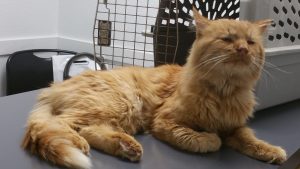
Oscar was prescribed antibiotics and Science Diet a/d (acute care diet) canned cat food. To quarantine him, I set up a dog crate beside an electric heater in the garage. I covered the crate with a sheet to hold in the heat, and set up a security camera so I could keep an eye on him from the house. The only thing that Oscar would eat was a small amount of the Science Diet a/d food mixed in warm milk to make a slurry that I fed him with a spoon. After several days Oscar began to improve, but had an eye infection I had to treat with an antibiotic ointment.
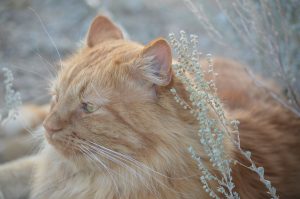
Finally well, I set Oscar up in an outbuilding that previously had housed chickens. He didn’t quite come across as a house cat yet, and he had been designated as a barn cat, though I don’t know why. Eventually, he would move into the house.
After Bootsie’s second litter, the long-haired black tomcat no longer returned; he was replaced by a long-haired orange tomcat. The errant wild female I hadn’t been able to catch had a litter of kittens with Long-haired Orange Kitty. I didn’t know where they were, and since it was during wintry weather, I thought it was likely they hadn’t survived. But one day I saw Tuxie carrying them one by one from beneath a chicken house across the yard to a tool shed.
One of them became a tortoiseshell-point mostly white-ish cat with flaming orange at the tips of her ears that glowed like flames in the sunset. I had first seen her that cold day as a roly-poly silver kitten carried through the snow by her mother, Tuxie, and so I dubbed her Snowball. She developed the tortoiseshell coloring on face, ears, feet, and tail as she matured — it was coloring I’d never heard of and hadn’t known existed. The others in the litter were Bouncer, Chevron, and Midnight.
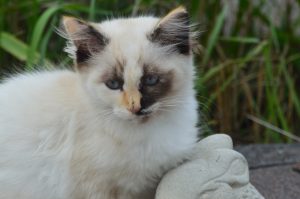
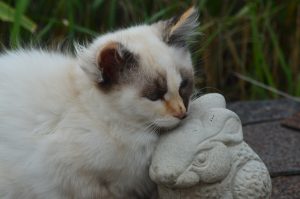
Tuxie and the Long-haired Orange Kitty had a second litter. One day in late August I heard kittens mewing in the yard south of the house, and found them in a corner where the entrance to the crawlspace jutted up against the house. They were in a nest of leaves beneath a rose bush. They had been there no more than a week when Tuxie failed to come for dinner at the patio. I searched and called, and finally gathered up the five kittens I was able to find in the twilight. They became bottle babies. I lost fifteen pounds over the course of three months mothering them!
Snowball began to look heavy, and though I’m not certain whether it was with winter coat or growing kittens, I’d have looked forward to her offspring. Sadly, she disappeared. I found bits of what could have been fur from her tail. A week or two later, I noticed similar fur in another location, and that Dora’s tail was shorter and upon closer inspection the bone could be seen. Something had to be done.
I bought 300 feet of field fence and two gates to fence in the driveway and back yard. Field fence is only four feet high, and has wound wire with graduated sized openings. I installed it upside down so that cats could run through the openings in the fence, but a larger animal such as a coyote could not. It helps, but the cats don’t always stay in the fenced-in area.